


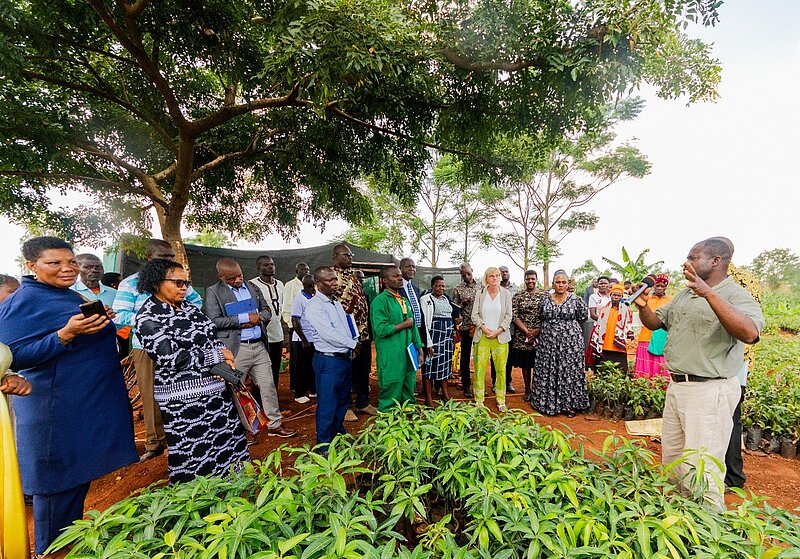
From 25 to 27 May 2026, adult education practitioners, government officials and Community Learning Centre (CLC) representatives from Tanzania and Uganda met for a cross-border exchange on Adult Learning and Education (ALE), organised by DVV International. This was not an introduction to CLCs for the Tanzanian delegation: both countries already run Adult and Non-Formal Education (ANFE) programmes using CLCs for literacy, skills development and community empowerment. The exchange offered a space for equals to compare experiences and identify approaches to strengthen implementation.
The 15-member Tanzanian delegation included the ANFE Desk Officer from the Ministry of Education, Science and Technology (MoEST), District Adult Education Officers, CLC Coordinators and DVV International Tanzania staff, hosted by Uganda's Ministry of Gender, Labour and Social Development (MGLSD), Namayingo District Local Government, Community Development Officers, CLC management committees, facilitators, vocational trainers and learners. The programme combined a field visit to Madowa Regional Model CLC with a reflection workshop in Jinja.
Two countries pursuing similar goals
Uganda and Tanzania use different names for their adult education programmes, but the exchange revealed substantial overlap. Uganda runs the Integrated Community Learning for Wealth Creation programme (ICOLEW) under MGLSD; Tanzania runs Integrated Community-Based Adult Education (ICBAE) under MoEST. Both aim to improve literacy and numeracy while helping people build practical skills and livelihoods, grounded in lifelong learning, decentralised implementation and collaboration among government, communities and partners. In both countries, CLCs serve as local hubs for literacy, vocational training and livelihood skills. They are supported by facilitators and management committees and guided by participatory planning. The two countries are pursuing similar objectives through different structures.
Shared priorities and shared challenges
Discussions surfaced common priorities: literacy and numeracy, vocational training, entrepreneurship, facilitator development and CLC sustainability, as well as common challenges: limited funding, inadequate infrastructure, insufficient vocational equipment, and difficulty retaining learners whose attendance is affected by farming seasons and household responsibilities. Both programmes need continuous refresher training and stronger documentation, and both need to reduce dependence on donor funding through government financing and income-generating activities. As the exchange illustrated, literacy and vocational training work best as one integrated pathway rather than separate interventions.


