


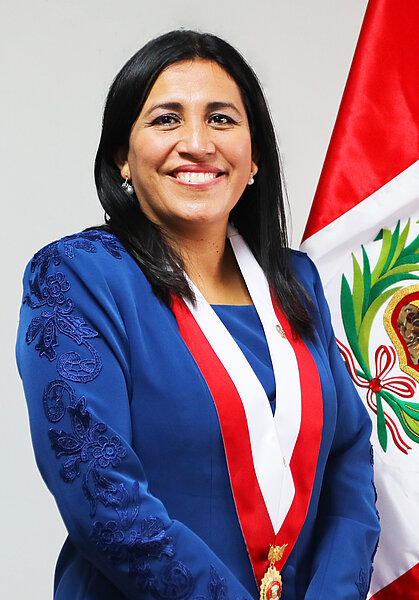
Peruvian Congresswoman Flor Pablo Medina explains the scope of an initiative that seeks to guarantee the right to education for more than 8 million people who have not completed basic education in the country.
In Peru, more than 8 million people over the age of 15 have not completed basic education. This situation is compounded by a high rate of participation in the informal labour sector, which exceeds 70%, and youth unemployment above 10%. In response to this situation, the Advocacy Group for Youth and Adult Education, with the technical support of DVV International, is promoting a bill to create a national system for youth and adult education.
Peruvian Congresswoman Flor Pablo Medina explains how this proposal seeks to address one of the country’s main educational gaps and what the next steps are for the proposal to become law. Flor Pablo Medina is a Peruvian educator and politician, currently serving as a member of Congress for the 2021–2026 term. She previously served as Minister of Education between 2019 and 2020 and has extensive experience in the design and implementation of educational policies, especially those aimed at populations in vulnerable situations. Within Congress, she has promoted initiatives related to the right to education and equal opportunities and has supported the process of developing the bill to create the National System for Youth and Adult Education.
What does the bill consist of and why is it so relevant in the current context of Peru?
The bill seeks to create a national system for youth and adult education to address two very important public problems. The first is that more than 8 million people in the country have not completed primary or secondary education, which seriously limits their opportunities for personal, professional, and civic development. The second problem is that these marginalised young people and adults are already part of the country’s productive dynamics. They are men and women who work, start businesses, or support their families, but in many cases they do so under informal conditions and without the tools necessary to improve their opportunities. What the bill aims to do is reach this population that the education system has left behind and strengthen the country’s human capital. It also has a very important civic component: a person who cannot understand what they read or who does not have basic tools to function in a literate world faces greater difficulties in fully exercising their citizenship, even when it comes to making informed decisions.
How was this legislative proposal developed, and which actors participated in its preparation?
The proposal is the result of a joint working process with various institutions that are part of the Advocacy Group for Youth and Adult Education and with allies such as DVV International. The process has been underway for several years. When I was Minister of Education in 2019, the magnitude of the problem and the lack of coordination between institutions had already been identified. From that moment on, we created spaces for dialogue and technical work, which made it possible to draft a document with consensus among different actors from the state and civil society. For this reason, it is a proposal that not only has legality, but also legitimacy. In addition, efforts have been made to ensure that it is a multiparty proposal; it does not respond to a single political group, but to a national need.
How does the bill propose improving services for young people and adults?
One of the main contributions of the bill is that it proposes a new form of governance for youth and adult education. This is a complex problem that involves millions of people and cannot be addressed solely by the Ministry of Education. Therefore, the proposal puts forward an institutional framework that allows coordination with other sectors such as labour, production, and regional and local governments. It also seeks to strengthen the territorial approach in order to reach even the most remote communities in the country. The idea is to have a system that makes it possible to develop the capacities of young people and adults so that they can become more productive, improve their quality of life, and fully exercise their citizenship.
What are the next steps for this proposal to become law?
The bill has already been submitted to Congress, and the next step is to continue the process to secure its approval. In this new context, it will be important for the newly elected members of Congress to take up this proposal, make it their own, and continue to promote it. The technical work is already well advanced: What is needed now is political management so that it can be approved.
What changes do you expect for the country if this law is approved?
The approval of this law would make it possible to move forward in a concrete way in guaranteeing the right to education for millions of young people and adults in Peru who have been excluded from the education system. It would also strengthen the country’s human capital, improve employment opportunities for many people, and contribute to a more informed and participatory citizenship. There can be no strong democracy if the right to education for all is not guaranteed.