Professionalisation in adult learning and education: Shaping the future of ALE in Uganda

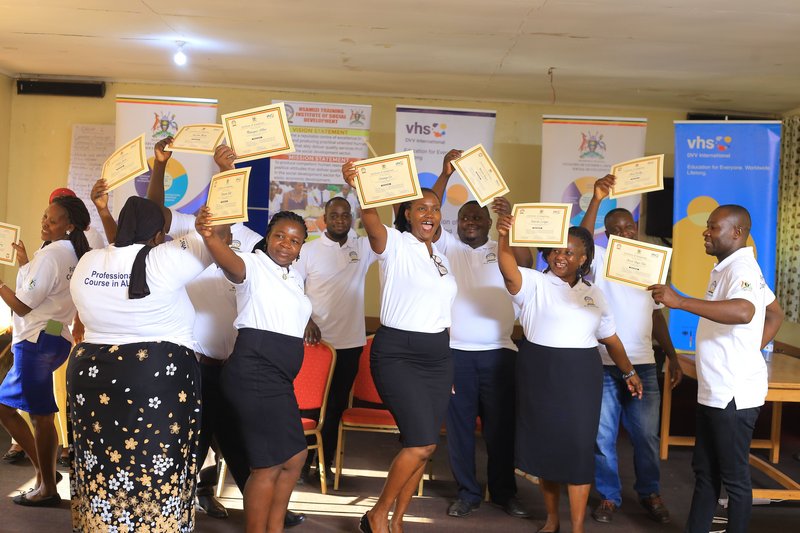
A group of people are standing together in a room, holding their certificates up in the air.
Participants in the pilot ALCE Professional Course showing off their certificates after completing a three-month course at Nsamizi Training Institute of Social Development.

Building a stronger foundation for adult learning and community education

Professionalising adult learning and education (ALE) is essential to improving the quality, relevance and impact of learning opportunities for adults and communities. In Uganda, an important step towards this goal is the development and rollout of the Professional Course in Adult Learning and Community Education (ALCE), designed to equip adult education practitioners with the knowledge, skills and competencies needed to deliver effective learning programmes.

The course is the result of a partnership between DVV International, Uganda’s Ministry of Gender, Labour and Social Development (MGLSD), Nsamizi Training Institute of Social Development and Makerere University. Adapted from Curriculum globALE, an internationally recognised framework for the professional development of adult educators, the course has been tailored to Uganda’s institutional context, national priorities and the practical needs of adult learning practitioners.

Following a comprehensive training needs assessment, the development of an ALE competency framework and curriculum, and a successful pilot phase, the ALCE Professional Course is now being rolled out to support practitioners implementing adult learning and community education programmes at district and sub-county levels. A key target group is government Community Development Officers (CDOs), who play an important role in implementing the Integrated Community Learning for Wealth Creation (ICOLEW) programme.

Through this initiative, Uganda is taking a significant step towards establishing a stronger professional foundation for adult educators and strengthening the delivery of adult learning and community education across the country.

Responding to an identified need for professional training

The development of the ALCE Professional Course responds to a longstanding gap in the professional preparation of adult educators in Uganda.

The Marrakech Framework for Action (2022) highlights the central role of adult educators in ensuring quality learning and calls for the professionalisation of adult learning and education. Similar commitments are reflected in the 2030 Agenda for Sustainable Development, particularly Sustainable Development Goal 4, and the Continental Education Strategy for Africa.

In Uganda, a 2021 peer review and analysis of the Adult Learning and Education System Building Approach (ALESBA) identified the absence of standardised training for adult educators and managers within the ALE system. This finding underscored the need for a structured approach to professional development based on recognised competencies and adapted to the national context.

In response, DVV International introduced the Curriculum globALE framework as a foundation for developing professional training for adult educators. In 2023, five representatives from the MGLSD, Nsamizi Training Institute of Social Development and Makerere University participated in a comprehensive regional Curriculum globALE training programme alongside selected participants from other DVV International partner countries in East Africa - Ethiopia and Tanzania. Upon completing the programme, they became certified Curriculum globALE Master Trainers, tasked with developing a national professional development programme for adult educators.

A further opportunity emerged in 2024, when Uganda’s Ministry of Public Service updated the job descriptions and person specifications for local government positions. These included a requirement for District Community Development Officers (DCDOs) to hold a certificate in training adult educators. However, implementation of this requirement was constrained by the lack of an established institution offering an appropriate certificate programme.

This created a clear entry point for the Curriculum globALE Master Trainers to develop a professional course specifically designed for Uganda’s adult learning and community education sector.

From international competencies to local practice

To ensure that the course would respond to the realities of adult education in Uganda, a training needs assessment was conducted in 2025 among CDOs and other ALE practitioners working with non-governmental organisations.

The findings revealed a significant need for professional development: 90 per cent of the ALE practitioners interviewed reported lacking knowledge and training in the field. At the same time, the assessment identified a strong interest in opportunities to strengthen their professional knowledge and skills.

Building on these findings, the Master Trainers used the Curriculum globALE competency framework as a starting point and contextualised it by reviewing the official job descriptions and person specifications for CDOs. This process helped to ensure that the curriculum addressed both identified learning needs and the professional requirements of practitioners working within Uganda’s local government structures.

The modular course combines internationally recognised competencies with relevant content, practical learning tools and approaches suited to the country’s adult learning and community education programmes.

Its learner-centred, experience-based methodology encourages participants to draw on their existing knowledge, reflect on their professional experiences and apply new learning to their daily work. A particular highlight is the individual change-making project, through which each participant demonstrates how newly acquired knowledge and skills can be translated into practical action in a real-life setting.

By connecting professional learning with workplace practice, the course aims to ensure that training goes beyond the acquisition of theoretical knowledge and contributes to meaningful improvements in the delivery of adult learning and community education.

Testing the approach and preparing for national rollout

Before its wider implementation, the ALCE Professional Course was piloted over three months to assess the relevance of its content, teaching methods and learning approaches.

Fifteen Community Development Officers completed the pilot. Their evaluations indicated that they had gained knowledge and skills relevant to their daily responsibilities and professional practice, providing encouraging feedback on the course’s practical value.

Building on this experience, preparations were made to establish the capacity needed for delivery across Uganda. Fifteen trainers were selected based on their professional and training backgrounds, with attention to regional representation. The group included District Community Development Officers and personnel from Nsamizi Training Institute’s regional training centres.

The trainers completed an intensive ten-day Training of Trainers programme, preparing them to deliver the ALCE Professional Course and support the development of professional competencies among adult educators in different parts of the country.

The initiative was welcomed by Mr Ocaki Samuel, DCDO of Zombo District and National Chairperson of DCDOs in Uganda, during the award ceremony for participants who completed the Training of Trainers course at Nsamizi Training Institute of Social Development.

He highlighted the course’s importance in addressing a critical gap in professional training and removing a major obstacle to implementing the revised job requirements. His remarks reflected a wider challenge faced by many Community Development Officers, who play a frontline role in adult learning and community education but have had limited access to specialised professional training in the field.

Investing in the future of adult learning and education

The ALCE Professional Course represents more than the introduction of a new training programme. It is a practical contribution to the broader professionalisation of adult learning and education in Uganda.

By combining an internationally recognised competency framework with national policy priorities, identified training needs and the realities of community development work, the course provides a structured foundation for strengthening the knowledge, skills and professional practice of adult educators.

The partnership between DVV International, the MGLSD, Nsamizi Training Institute of Social Development and Makerere University also demonstrates the importance of collaboration in developing sustainable approaches to professional development. By bringing together institutional expertise and practical experience, the partners have laid the groundwork for a course that responds to the needs of practitioners and the requirements of the national ALE system.

As the programme moves towards wider implementation, it offers an important opportunity to strengthen the capacity of Community Development Officers and other adult learning practitioners to support meaningful learning experiences within their communities.

Ultimately, investing in the professional development of adult educators is an investment in the quality and relevance of adult learning itself. The ALCE Professional Course marks an important step towards a more professional, responsive and effective adult learning and community education sector in Uganda - one that is better equipped to meet the learning needs of adults and contribute to community development.

The authors

Caesar Kyebakola and Frauke Heinze

Caesar Kyebakola is Country Director of DVV International in Uganda. Frauke Heinze is the Regional Director of DVV International for East/Horn of Africa.