With the arrival of Covid-19 to our social and educational world, we have had to enhance synchronous, asynchronous and at a distance hybrid processes, with the help of virtual tools and communication platforms in order to provide educational offerings and generate dialogues between civil organizations, academic and educational institutions and governments around the right to Adult Learning and Education (ALE).
We have found that virtuality also unites us, and that our work, challenges and progress in ALE are also common in other territories, with other people and institutions.
Digital radio and online initiatives
In 2021, we rediscovered the potential of digital radio. Through Radio EPJA-ALE, and its serial “Resonate the South – educational experiences in dialogue” (“Resonar el Sur, experiencias educativas en diálogo”), we generate dialogues and reflections with educational and government institutions, universities and civil society organizations, linked to the topics of migration, education and development.
In April and July 2021 the sub-regional consultations in Latin America and the Caribbean, prior to the Seventh International Conference on Adult Education (CONFINTEA), served as a motivator for DVV International and the Regional Cooperation Center for Adult Education in Latin America (CREFAL), to create the “Meeting of ALE governmental bodies in Mexico, Central America and the Caribbean” in an online format.
During 2022 and 2023, we held the first and second online "Meetings of ALE governmental bodies in Mexico, Central America and the Caribbean" with representatives of governments, civil society organizations and educators from Costa Rica, Cuba, El Salvador, Guatemala, Honduras, Mexico, Nicaragua, Panama, Dominican Republic and Chile. We shared educational policies, local initiatives, lessons learned, forms of organization and local innovations in order to learn about what is done in each country and thus enrich the work of all.
With these initiatives, we reached more people in territories we had not reached before, and generated synergies we had not known about.
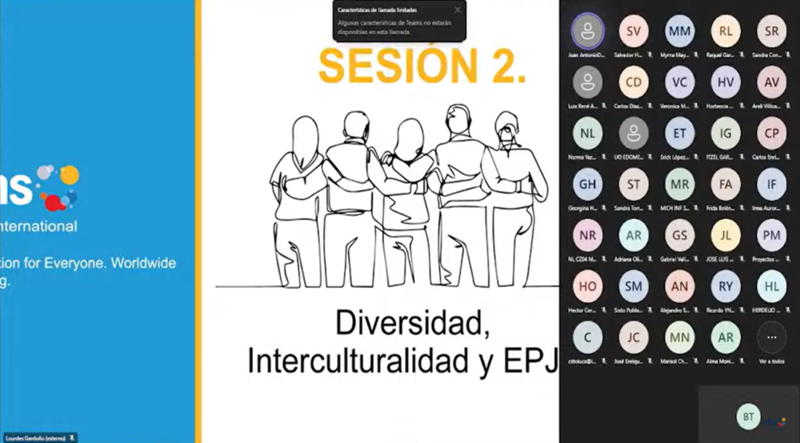
In 2023, we developed what we call the “Territorial Extension Proposal”, which as a first initiative included four online Awareness, Reflection and Analysis Sessions on Human Rights and ALE Law, Diversity and Interculturality, Gender and ALE and Migration and ALE, aimed at staff of the National Institute for Adult Education (INEA) in Baja California Sur, Michoacán, Nuevo León, State of Mexico and Mexico City.
This initiative is a call to public officials and academics linked to ALE to generate actions and make decisions for the common good, to assume responsibility for promoting, defending and guaranteeing human rights, and to ask themselves: How does what I do impact people? What rights are we promoting with young people and adults?
New opportunities and new challenges
All these local, national and regional reflection events have invited us to rethink educational forms and methodological concerns in our region, and have highlighted the educational and training opportunities of virtuality:
- Online training offers flexibility in terms of location and time. We can teach and learn at a distance, at our own pace and asynchronously.
- In addition, it is more affordable than face-to-face education (in most cases), by reducing costs for the use of facilities and the purchase of educational materials (free or low-cost virtual resources).
- Digital platforms provide unlimited resources for teaching and learning: interactive tools, video, audio and image materials, access to forums and training events; in addition, they are adaptable to different learning styles, which enhances the educational experience.
- The skills and knowledge learned in the virtual world can be immediately applicable, both in personal life and at work, increasing a person’s motivation to continue training and/or obtain better opportunities.
- Virtual training provides accessibility to wider audiences, which would not be possible due to geographical or physical limitations.
- It also personalizes audiences, segmenting them according to their educational interests, teaching and/or learning styles, times and formats.
- Virtual events provide opportunities to connect with people around the world, with whom we can exchange knowledge and experience that contributes to our professional and personal lives.
- They also motivate lifelong learning, giving people continuous access to educational offerings (with updated content) and new training programs in different areas of knowledge.
At this moment, virtuality is giving us some answers on how to boost access to education, for all people, all over the world, throughout life. At the same time, there are still many questions and challenges, such as:
- Who has access to internet coverage? Why are people excluded?
- Who has access to digital devices? And who can afford them?
- Who has the knowledge and skills for the use of technology?
- What challenges do adults face with regards to online education?
- How should we (further) update our educational offerings?
- How do we contribute to the construction of an accessible and adaptable quality online education?
At DVV International we know that with time we will solve these questions, confident that we have the most important answer of all: Education is the engine to dignify life.
Links to resources (all in Spanish)
Digital radio series Resonate the South – educational experiences in dialogue
Online meetings: Meeting of ALE governmental bodies in Mexico, Central America and the Caribbean (PDF)
Online meetings: Awareness, Reflection and Analysis Sessions