


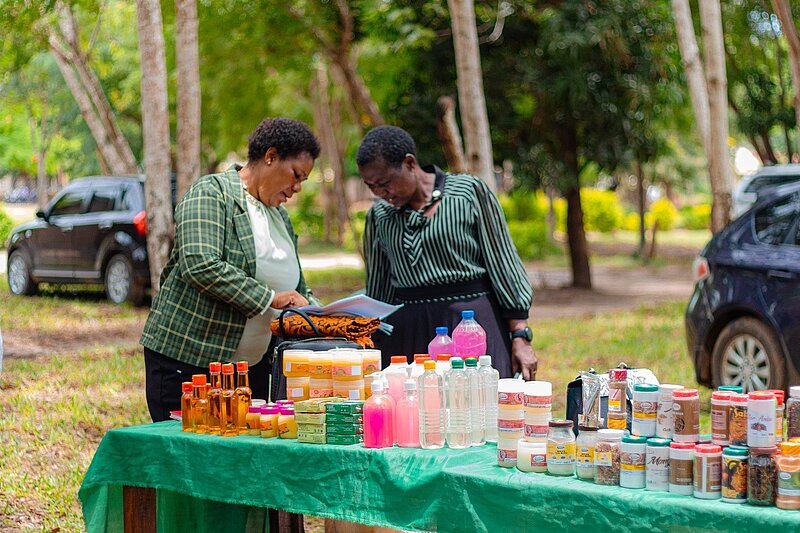
When people talk about the Ruvu JKT Community Learning Centre in Kibaha, they tend to discuss the fish ponds, the vibrant batik fabrics, the women who built businesses from scratch, and the men who finally secured their driving licences. They talk about the visible things. What is less often talked about, but what makes all of those stories possible, is the architecture underneath. The governance, the cross-departmental coordination, the financial modelling, and the way district budgets are passed. That part of the picture is less photogenic, but it is the true engine of the centre.
And at Ruvu JKT, it is working.
Rooted in community context analysis
The Ruvu JKT CLC did not begin with a building and a pre-packaged programme. It began with a question. Teacher Nasikiwa Mbwambo, the centre’s coordinator, describes how the team went out to the five sub-villages of Mtambani ward before anything was set up to conduct a rigorous community context analysis. “We discovered that the needs of many community members focused on areas of agriculture and livestock, which they are heavily involved in, especially fish farming,” she explains. “We are near the Ruvu River, and more than three-quarters of the residents here engage in fishing for their livelihoods. We saw this as our starting point.” That survey shaped everything that followed. The fish pond, the vegetable garden, the vocational workshops – none of these initiatives were modelled on a template. They were built to answer specific local demands. This alignment is the core of DVV International’s Adult Learning and Education System Building Approach (ALESBA), ensuring the centre acts as a true hub for lifelong learning rather than a rigid, traditional school.


