


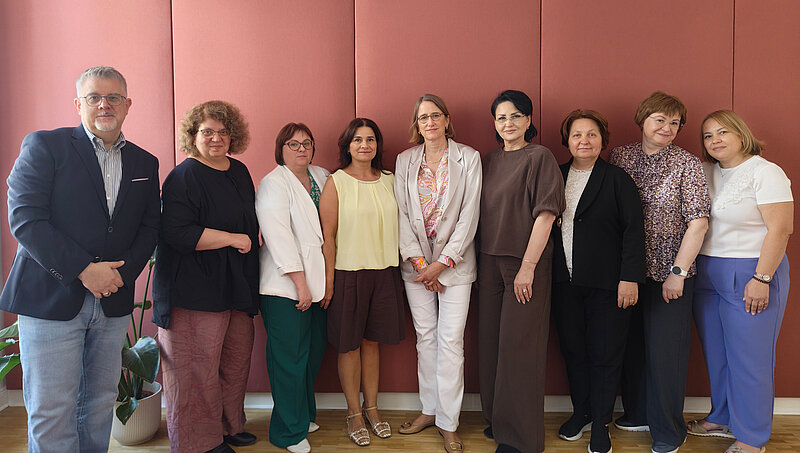
How is adult learning and education (ALE) organised in Germany? What is the legal framework at federal state level? How are ALE institutions funded, and which stakeholders shape the sector? A high-level delegation from the Republic of Moldova explored these questions during a visit to Germany from 13 to 18 July 2026.
Among the participants were Liliana Nicolaescu-Onofrei, Chair of the Education Committee of the national parliament; Dr Ludmila Stihi, State Secretary at the Ministry of Education; and other key decision-makers from the Ministry of Education and the city administration of the Moldovan capital, Chişinău.
The study tour, organised by DVV International in collaboration with the adult education centres in Berlin Mitte and Rostock and the UNESCO Institute for Lifelong Learning (UIL), and financially supported by the Federal Ministry for Economic Cooperation and Development (BMZ), took the delegation to Berlin, Hamburg and Rostock. The visit to Berlin began with a visit to the German Adult Education Association (DVV), where the Association’s Director, Julia von Westerholt, together with colleagues from DVV International, welcomed the guests and presented the Association’s work. This was followed by a discussion on current policy issues facing the association; in addition, Levan Kvatchadze, Regional Director for Eastern Neighbours at DVV International, gave the delegation an introduction to the German ALE system.
The following day, the guests visited vhs Berlin Mitte, the largest of the capital’s twelve adult education centres. Together with Sabine Grabow from the Berlin Senate, Stephanie Vonscheidt, Head of the Service Centre for Berlin’s Adult Education Centres, and Manjiri Palicha, Head of the Adult Education Centre, and her team, they discussed the work of the vhs and the specific features of Berlin’s Adult Education Act, as well as funding for adult education centres and other recognised providers.
The programme in Hamburg began with a visit to the UIL. Institute Director Isabell Kempf and her team provided an overview of their key areas of work, including international UNESCO programmes on adult learning and education, capacity building, the Global Network of Learning Cities and the Global Report on Adult Learning and Education (GRALE). In the afternoon, the group visited the House of the Bürgerschaft, where they were welcomed by Cornelia Nienstedt, Head of the State Office within the Hamburg Senate. Afterwards, Ralf Behrens and Jürgen Forkel-Schubert from the City Authority for Environment and Energy presented Hamburg as a ‘Learning City’. As one of four cities in Germany, the Hanseatic city has been part of the UNESCO ‘Learning Cities’ programme since 2019 and is primarily involved in the field of Education for Sustainable Development (ESD).
The guests spent the last two days of the study tour in Rostock. The director of the local adult education centre (vhs), Jörg Otto Czimzik, and his team had put together a varied programme of activities, which, in addition to discussions with colleagues from the vhs, included a meeting with Thomas Jackl, head of department at the Ministry of Education and Childcare in Mecklenburg-Western Pomerania, and Maren Akobi, director of the vhs regional association. In addition, the Moldovan delegation met Marcela Macaru and learnt about the work of the association Diaspora Moldova e.V.
The week-long trip enabled the Moldovan guests to gain in-depth and practical insights into the adult learning and education system in Germany, whilst also learning about and reflecting on the different legal frameworks in the individual federal states.
The insights gained are particularly significant in light of the Republic of Moldova’s ongoing EU accession process and the reforms of local government structures. The insights into the federally organised ALE system and the role of adult education centres at local level provided the delegation with valuable ideas for a possible reorganisation of the Moldovan ALE system. At the same time, it became clear what contribution an effectiveALE system can make to the skills development of the population, to strengthening democratic structures and to the successful implementation of social reform processes.