


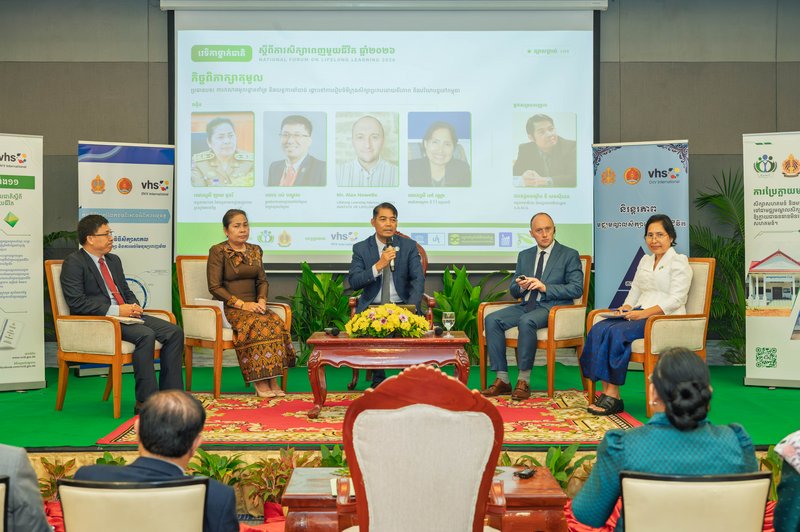
What does it take to turn a national lifelong learning policy into learning opportunities in every community? On 30 October 2026, government representatives, development partners and practitioners came together in Phnom Penh to begin answering this question.
Two national events took place that day: in the morning, the first formal meeting of Cambodia’s National Committee for Lifelong Learning (NCLLL); in the afternoon, the Third National Forum on Lifelong Learning. Together, they showed how far lifelong learning has moved up the national agenda, and how much now depends on implementation.
A whole-of-government framework
The NCLLL brings together 30 ministries and institutions. Its first meeting was chaired by H.E. Dr Academician Hang Chuon Naron, Deputy Prime Minister and Minister of Education, Youth and Sport. The Committee adopted its rules of procedure and an Action Plan to implement the National Policy on Lifelong Learning through 2028.
This marks a crucial recognition of lifelong learning as a task that extends beyond the education sector alone. Skills, jobs, climate action and digitalisation all depend on it, as does effective cooperation between ministries.
The Deputy Prime Minister called for regular meetings, continuous monitoring and annual progress reports. A mid-term review is planned for 2027, followed by a final evaluation in 2028.
Learning centres at the heart of communities
In the afternoon, the forum explored how lifelong learning can reach people where they live. Chaired by H.E. Nos Sles, Secretary of State and Permanent Vice-Chair of the NCLLL, it focused on Lifelong Learning Centres as “catalysts” for sustainable and inclusive community development.
Presentations linked learning with climate resilience, digital skills and the UNESCO Learning City approach. Cambodia is now preparing to join the UNESCO Global Network of Learning Cities, with applications expected to open in 2027.
A practical perspective came from the community level. Mr Prak Toeun, head of the model Lifelong Learning Centre in Srae Knong, in Kampot Province, explained how the centre responds to local needs and designs its courses around people’s livelihoods, from agriculture and handicrafts to digital skills, literacy and entrepreneurship.
A panel moderated by H.E. Dr Dy Sam Sideth, Secretary General of the NCLLL Secretariat, discussed the structures needed to build sustainable Learning Cities. One idea that emerged was to link Lifelong Learning Centres with community digital centres and make better use of existing infrastructure.
From policy to practice: the next few years
The framework is now in place. Will ministries integrate lifelong learning into their own plans and budgets? Can policy-makers turn ideas into practical measures that reach lifelong learners across society, especially those who have benefited least from formal education? And how will skills acquired outside formal education be recognised?
These questions will shape the coming years.
DVV International has worked in Cambodia since 2009 and has supported the development of the national policy and the Secretariat that coordinates its implementation. At the forum, Country Director Ms Peou Vanna delivered remarks and joined the panel. DVV International’s focal point at the Secretariat, Mr Phel Phearun, gave a presentation on digital citizenship.
Both the Deputy Prime Minister and H.E. Nos Sles thanked DVV International and other partners for their support. A cooperation agreement between DVV International and the Secretariat runs from 2026 to 2028, covering the same period as the Action Plan.
The forum was organised by the NCLLL Secretariat, with financial support from DVV International and technical support from the UNESCO Institute for Lifelong Learning, ODC, NEP and IT STEP Academy.