“Knowledge that grows” – Adult learning and education for a sustainable future

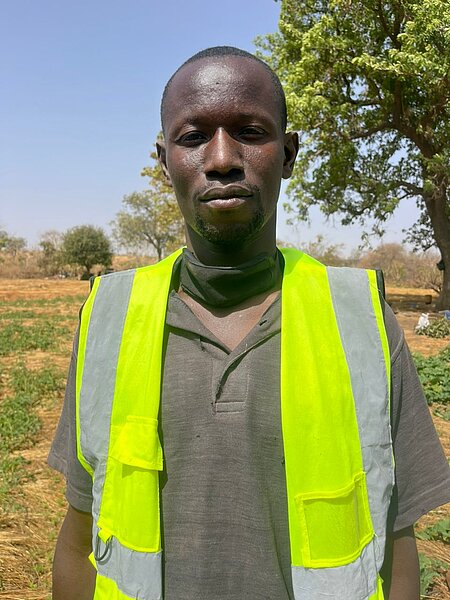
A young man stands outdoors in a field, looking directly at the camera. He is wearing a bright yellow safety vest.
Bourama Coulibaly, a farmer in Mali and a participant in the PASSIP project

As part of the PASSIP project in Mali, farmers in REFLECT learning circles are not only learning reading, writing and arithmetic, but are also developing sustainable farming methods and new sources of income. Bourama Coulibaly explains how adult learning and education is transforming his fields, his family, and village life.

Since November 2024, DVV International has been supporting a GIZ-funded project to implement the national programme for sustainable small-scale irrigated agriculture in Mali (PASSIP). The approach behind the project combines adult learning and education, environmental protection, and income-generating opportunities. A key part of the programme involves participatory REFLECT learning circles (Regenerated Freirean Literacy Through Empowering Community Techniques). In these groups, participants learn to read, write, and do arithmetic. At the same time, they analyse problems from their everyday lives while working and developing solutions together.

All participants also receive practical training in environmental protection and conservation. They then implement the environmental services identified in this process as part of paid, work-based initiatives. This combination of skills training, paid work, and expert support opens up new land suitable for agriculture, strengthens communities’ resilience to environmental problems, secures income, and creates sustainable employment opportunities.

Bourama Coulibaly is a farmer. During the rainy season, he grows maize, millet, rice, and other crops. During the dry season, he grows vegetables and garden crops. As part of the project, he is taking part in a REFLECT circle in Noumoussabougou in southern Mali. 

What motivated you to join one of the REFLECT circles?

I wanted to learn more about sustainable farming methods. My lack of knowledge was causing some problems in my daily life. For example, I didn’t know about agroforestry – that is, the combination of trees and crops on the same plot of land. I used to grow just a single crop in a field. In the learning circle, I learned about these methods and then put them into practice – both on my own field and on the land belonging to the REFLECT circle. Another problem was haphazard sowing. We used to plant without clear spacing. I’ve learned that the correct planting distances – depending on the seed – are crucial for yield and quality. If you maintain the distances instead of letting everything grow crammed together, every single plant produces more. These new techniques have helped me a great deal. A farmer constantly needs new ideas to keep developing.

What happens in the REFLECT circle – and what have you learned?

We discuss the planned work in the circle, share experiences and revise previous learning modules so that we don’t forget anything. We make all decisions regarding environmental measures together in the REFLECT circle. We have learned many new techniques: building stone walls to prevent erosion, making plant-based biopesticides, composting, and much more. But the most important achievement is the stronger sense of unity among us. We have learned to work together. Before the project, there was hardly any interaction between many of us – some didn’t even know each other beforehand. The circle has created new connections. Through cooperating and sharing ideas, we have learned how to listen to one another and respect everyone’s opinion – including that of the women. That wasn’t a given in the past. In the REFLECT circle, we’ve understood that every opinion counts. That’s why we sit in a circle when we discuss, so that everyone can speak freely. I’ve also introduced this principle in my family. We sit down together, listen to one another, and resolve our problems with mutual respect. This has significantly improved our family life.

What else has changed in your life?

A lot has changed since I took part. I’ve become more open-minded and now understand ideas that used to be foreign to me. My income has also improved: my fields are yielding significantly higher harvests. I also work on local infrastructure projects and receive financial remuneration as part of these work-based initiatives. I have invested this money wisely, for example in livestock: I have bought goats, sheep, and poultry. I have also been able to pay my children’s school fees.

Have you noticed any changes in your community?

Many changes are visible in the village: stone walls to prevent erosion, small dams made of clay sacks to repair washed-out paths, and drainage ditches lined with deadwood hedges. We have also made progress in the area of health. We used to use chemical pesticides that were harmful to our health. Today, we produce plant-based organic pesticides, which are cheaper because the materials are available locally. What’s more, we can eat the harvest straight after spraying – unlike with chemical products. Many people are now following our example and putting similar protective measures in place in their own fields. This positive example motivates many people – and that makes me particularly happy. I want to pass on my knowledge and teach others who also want to learn. 

What do you say to people who think they are too old to learn?

As long as you can think and understand, you can learn – even as an adult. I am proof of that myself. I am no longer young, and I never thought I could learn so much at this age. It is important to seize the opportunity.