


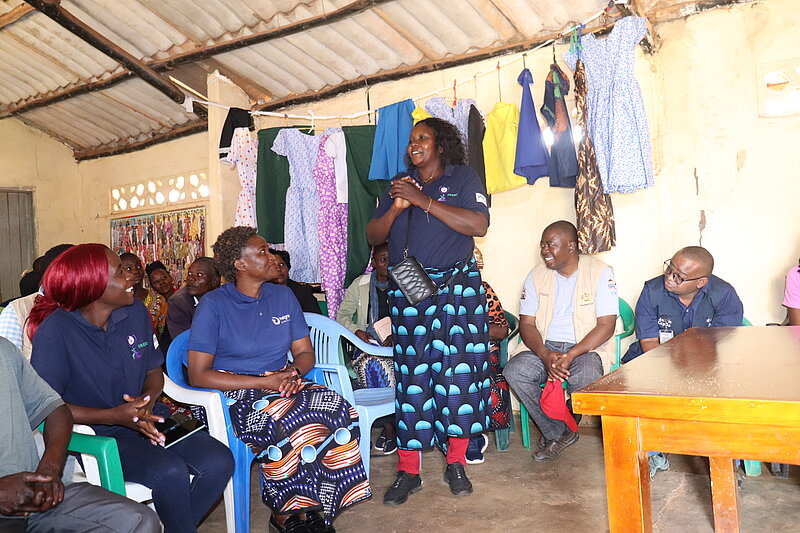
At the invitation of DVV International, adult educators from Mozambique exchanged ideas with Malawian colleagues about successful Community Learning Centres during a study visit to Malawi. The cross-border dialogue demonstrated the considerable potential of peer learning and regional cooperation.
DVV International’s two project countries in Southern Africa, Malawi and Mozambique, have much in common. They are at a similar stage of development, are largely rural in character, and in the field of adult learning and education (ALE) there is a high demand for catch-up basic education, literacy and basic vocational skills. However, they differ in many respects in terms of the nature of their ALE landscapes. In Malawi, for example, the structures of the Community Learning Centres (CLCs), which offer income-generating training for former participants in literacy courses as well as integrated ALE programmes, are significantly more developed, whilst Mozambique demonstrates strengths in the content of precisely these integrated programmes. A mutual exchange is therefore a natural step.
Until now, however, peer learning has been hampered by language barriers: the official language in Malawi is English, in Mozambique Portuguese. In early 2026, however, DVV International also began working in the Tete province of Mozambique, which borders Malawi. The advantage here is that Chichewa is spoken in large parts of Tete. This is the most widely spoken language in Malawi, so nothing stands in the way of easy communication.
Learning from and with one another
Against this backdrop, DVV International organised a study trip to Malawi for a Mozambican delegation from the province of Tete from 18 to 22 May. The aim was to gain a closer understanding of the structures of the CLCs in Malawi and to learn how they are locally embedded and supported at regional and national level. The Mozambican delegation consisted of 14 representatives from district and provincial levels who work in adult learning and education in either administrative or educational roles, as well as colleagues from the civil society partner OREMO (Organização Esperança de Moçambique).
In Malawi, DVV International currently supports seven CLCs in the districts of Ntchisi, Dowa, Mchinji and Ntcheu, with two further centres currently being established. Four of these CLCs were visited during the study trip. This enabled the participants to engage in in-depth discussions with the respective CLC management committees, teaching staff and students, and also to inspect the local surroundings. Particularly impressive were the encounters with former participants who had been able to establish their own small sources of income through the courses, such as in the field of tailoring. Members of the Mozambican delegation were delighted to witness a trained female bricklayer instructing male students at a CLC in Mchinji. “It is very important that we break down gender stereotypes in Mozambique too. Every profession should be open to every gender”, remarked one participant.
The visit was rounded off by a reception at the German Embassy in Lilongwe, a meeting with the National Centre for Literacy and Adult Education (NACLAE) and a presentation of the DVV International project portfolio at the regional office. With the newly gained experience, the Mozambican colleagues can now take further steps towards establishing Community Learning Centres, supported by future exchanges and continued peer support from their Malawian colleagues.