


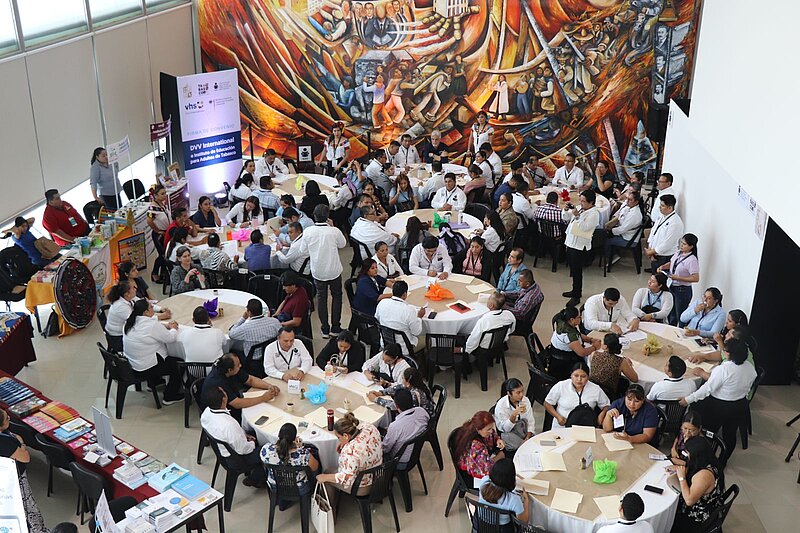
On 18 and 19 November, DVV International and the Tabasco Institute for Adult Education hosted the “Intercultural Forum: Experiences, Challenges, and Obstacles in Education in Contexts of Cultural Diversity” in Tabasco, Mexico. The event gathered more than 350 participants – including specialists, teachers, academic authorities, and key community stakeholders from Mexico, Guatemala, and Ecuador – to reflect on the challenges and opportunities of intercultural education in culturally diverse settings.
Education in Latin America is marked by deep cultural diversity. Yet, traditional pedagogies and adult learning and education (ALE) systems are often not designed to respond adequately to the needs and worldviews of indigenous, peasant, and bilingual communities, which, in turn, perpetuates exclusion. Interculturalism plays a fundamental role in countering this issue, as it promotes inclusion by recognising and valuing ancestral knowledge and local wisdom as essential curricular elements.
The event, held in the auditorium of the Juárez Autonomous University of Tabasco, provided a regional space for reflection, dialogue, and action. It brought together representatives from various sectors in Mexico, including universities, the national ALE institute, public adult education providers, and civil society organisations. Delegations from Guatemala’s National Literacy Committee and DVV International Ecuador also participated.
From conceptual debate to practical application
The conference effectively bridged theory and practice. Dr Antonio Saldívar from The College of the Southern Border and Dr Mauricio Hernández Sánchez from the Intercultural University of the State of Tabasco delivered the conceptual framework in a keynote lecture. Their contributions fed into the World Coffee on Interculturalism, a dynamic exchange format that invited participants to develop concrete proposals around fundamental questions on the role of interculturalism in educational processes. Parallel to this, the Inter-institutional Dialogues enabled directors from different education institutions to share how they integrate interculturalism within their areas of work.
The second day shifted the focus toward practical implementation through an Educational Experiences Fair and a series of simultaneous workshops. The topics showcased the application of interculturalism in key thematic areas:
- Environment (Moxviquil)
- Positioning of women in education (Casa de la Mujer – CAM)
- Socio-emotional skills (Tabasco Institute for Adult Education)
- Education for young people and adults (Tabasco Institute for Adult Education)
- Traditional medicine (Intercultural University of the State of Tabasco)
Towards a more equitable and transformative ALE
The event facilitated an in-depth reflection on persistent challenges, the strengthening of local practices, and the consolidation of collaborative networks among government, academia, and civil society. As the director of the Tabasco Institute for Adult Education highlighted, this effort requiring co-construction and active listening to local knowledge is essential for educational relevance.
The Intercultural Forum 2025 concluded with the signing of a collaboration agreement between the Tabasco Institute for Adult Education and DVV International, represented by Ana Silvia Fuentes Falconi and Susanna Hess-Kalcher, respectively.
DVV International thereby reaffirms its role as a facilitator of spaces for dialogue and mutual learning. The success of this forum represents an important step toward establishing a more relevant, equitable, and transformative ALE for communities in southeastern Mexico, ensuring that educational programmes are rooted in the cultural richness and lived realities of the people.