


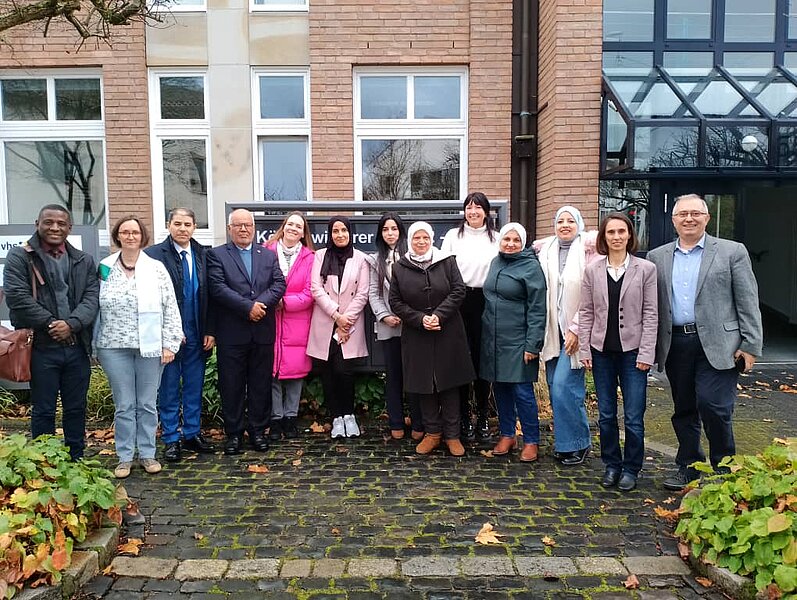
At the invitation of DVV International, an Algerian delegation travelled to Germany from 23 to 28 November to learn more about the work of adult education centres and the system of (non-formal) adult learning and education, as well as to exchange ideas with their German colleagues.
The seven-member delegation included representatives from three Algerian ministries that are central to adult learning and education (ALE): the Ministry of Education, the Ministry of Vocational Training and the Ministry of Agriculture.
Diverse, accessible, needs-based: the Volkshochschulen in Germany
During their visit, the Algerian visitors had the opportunity to familiarise themselves with the work of the German Adult Education Association (Deutscher Volkshochschul-Verband, DVV) at all levels: from the national umbrella organisation to the regional state associations and the work carried out by local ALE centres (Volkshochschulen – vhs).
Visits to the vhs Rhein-Sieg and vhs Frankfurt gave the delegation a chance to learn about the work and local significance of Volkshochschulen. The delegation was impressed by the wide range of courses offered by the vhs and exchanged ideas with their German colleagues on different topics, including needs assessment, quality assurance, professionalisation of teachers, as well as digitisation and artificial intelligence.
Algeria itself has extensive expertise and many years of experience in fields such as literacy, vocational training and agricultural education. Therefore, the focus of the entire trip was on exchanging experiences and mutual learning.
Municipal responsibility for ALE in Germany
A vibrant discussion took place about the role of local authorities in providing adult learning and education. The topic arose not only in discussions with the Volkshochschulen but also during a visit to the Department for General Continuing Education at the Ministry of Culture and Science of the state of North Rhine-Westphalia. In this area of Germany, an important legal basis is provided by the Further Education Act of North Rhine-Westphalia, which defines the establishment and maintenance of Volkshochschulen as a ‘mandatory task’ of local authorities.
In this context, the Algerian delegation was acutely interested in the work of the Statewide Further Education Council of North Rhine-Westphalia. The council consists of representatives of the ministry and recognised further education organisations, including Volkshochschulen. It advises the ministry on all matters relating to general continuing education.
Further stops of the study trip included the Federal Ministry for Economic Cooperation and Development (BMZ), the Federal Institute for Vocational Education and Training (BIBB), the German Institute for Adult Education (DIE) and the Wuppermann Educational Centre.
Inspiration for further cooperation
At the end of the trip, the participants emphasised the exemplary role of the German ALE system in general and Volkshochschulen in particular. They highlighted multiple takeaways, including the professional management of the vhs, its consistent focus on the needs of different target groups, and its integration of current social issues, for example in the areas of artificial intelligence, political education and sustainable economics.
The legal recognition of non-formal ALE and its municipal support were also seen as key success factors, with positive effects on a stable labour market and social cohesion. In addition, the delegation perceived the strong role of civil society organisations in the German continuing education system as an inspiring model.
The experiences and insights gained during the study trip will be incorporated into the further cooperation between DVV International and its partners in Algeria – for example, in promoting cross-sectoral cooperation and developing a common vision, or in areas such as the professionalisation of teachers and digital forms of teaching.