


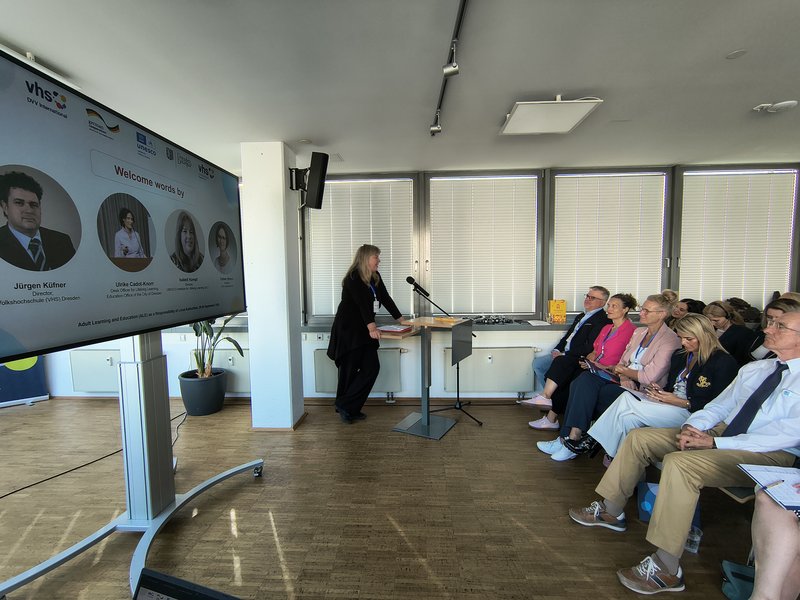
How can local authorities drive lifelong learning forward? Around 60 experts from more than ten countries explored this question in Dresden on 29 and 30 September 2026.
Representatives of local authorities, education providers, civil society, think tanks and international organisations gathered in Dresden for the conference "Adult Learning and Education as a Responsibility of Local Authorities". Participants travelled from Armenia, Bosnia and Herzegovina, Georgia, Kosovo, Moldova and Ukraine, together with guests from Germany, Poland, Slovakia, South Korea and other countries.
The conference was organised by DVV International together with the UNESCO Institute for Lifelong Learning (UIL), the City of Dresden and Volkshochschule (vhs) Dresden. Opening remarks were given by Jürgen Küfner (Director of vhs Dresden), Ulrike Cadot-Knorr (Senior Desk Officer for Lifelong Learning, City of Dresden), Isabell Kempf (Director of UIL) and Esther Hirsch (Acting Director of DVV International).
In her keynote, Isabell Kempf framed one of the conference's central question:
“Our cities are going to change, whether we plan for it or not. What we can influence is whether people get the chance to learn their way through that change, and whether they do it together or alone.”
– Isabell Kempf, UIL-Director
During the event, international experts gave presentations on governance, financing and participation. DVV International also presented the key messages of its recently published expert paper on adult learning and education as a responsibility of local authorities.
Learning from each other
A central part of the conference was the exchange of practical experience from different countries and cities. Participants presented examples of successful cooperation between adult education providers and municipalities, on local policy developments, and on ways to strengthen learning opportunities in their communities. One finding stood out: there is no one-size-fits-all model. Responsibilities, legislation and financing differ from country to country. Everywhere, however, strong partnerships and local commitment proved essential. Preliminary findings from a Social Return on Investment (SROI) analysis of adult education centres in Georgia and Armenia were also presented. The subsequent discussion focused on what such centres contribute to individuals, communities and local development. Examples from Germany, Poland, South Korea and other countries demonstrated how lifelong learning could be an important tool to promote local development and ,in particular , the development of people.
Dresden as a Learning City
The second day focused on Dresden itself. The city has been part of the UNESCO Global Network of Learning Cities since 2024 and has since built up a range of lifelong learning opportunities. Jan Donhauser, first Mayor and Councillor for Education, Youth and Sports, welcomed the guests. During a visit to the Kulturpalast, home to the city library, the Dresden Philharmonic and the COSMO Science Forum, participants saw how local cultural and educational institutions promote learning and civic engagement.
From exchange to action
The conference was not meant to stop at an exchange of experience. In an interactive session, participants considered which approaches could be transferred to other places and what steps should follow next. The conference continues the cooperation between DVV International and UIL on the role of local authorities in adult learning and education (ALE). It was funded by the German Federal Ministry for Economic Cooperation and Development (BMZ) as part of DVV International's European Continental Project.