


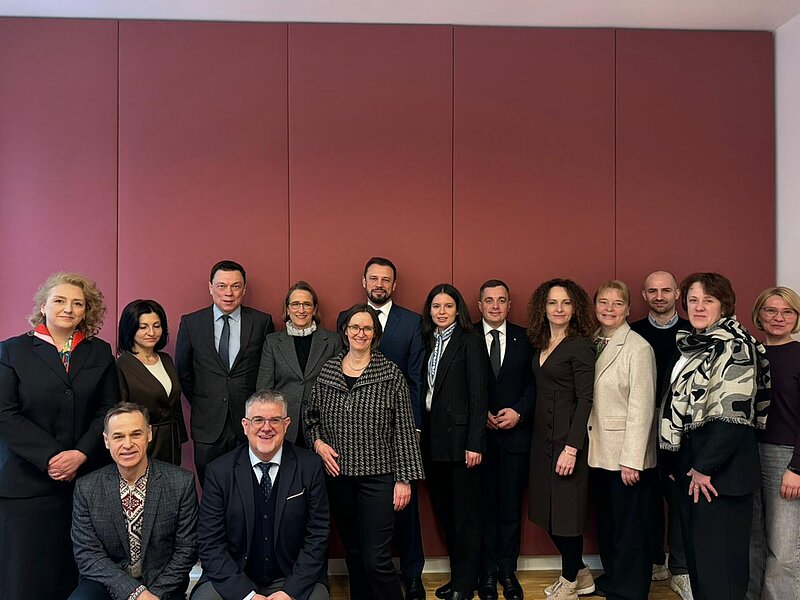
From 25 to 31 January, a high-level Ukrainian delegation conducted a study visit to Germany and Switzerland to learn about adult learning and education (ALE) systems, governance structures, and funding mechanisms, and to strengthen professional exchange with key European partners.
The delegation included parliamentarians and representatives from the Ukrainian Ministry of Education, among them the Deputy Minister of Education and Science, Prof Dr Mykola Trofymenko. The visit was organised by DVV International in partnership with the Bavarian Adult Education Association (bvv) and the Swiss Federation for Adult Learning (SVEB) with financial support from the Federal Ministry for Economic Cooperation and Development (BMZ).
The visit focused on the role of ALE in democratic development, social cohesion, and post-crisis recovery. Almost four years after the start of Russia's full-scale agression on Ukraine, the country's education system faces enormous challenges: the targeted destruction of civilian infrastructure, ongoing insecurity and massive migration are making it considerably more difficult to provide education throughout the country. Against this backdrop, the establishment of stable legal and institutional frameworks is becoming even more important.
In addition to professional exchange, the study visit therefore also supported Ukraine’s ongoing efforts to advance a comprehensive Adult Education Act. The law, which was passed by the Ukrainian Parliament in its first reading in January 2023, is the result of a long preparatory process in which DVV International, together with Ukrainian partners, provided technical expertise and support. With the legislation’s further progress stalled, the visit offered Ukrainian parliamentarians and government representatives first-hand insights into European legislative frameworks and governance models on national and local levels.
Learning from the German ALE system
The visit started in Berlin with meetings at the German Adult Education Association (Deutscher Volkshochschul-Verband, DVV), the umbrella organisation representing around 850 Volkshochschulen (ALE centres) across Germany. Participants discussed the organisation of ALE, international cooperation, and the contribution of lifelong learning to resilience and participation in society with Julia von Westerholt, Director of DVV, and Esther Hirsch, Acting Director of DVV International.
Further meetings in Berlin addressed the political and institutional framework of ALE. At the German Federal Parliament (Bundestag), the delegation held a meeting with Saskia Esken, Chair of the Parliamentary Committee on Education, Family Affairs, Senior Citizens, Women and Youth. The discussion focused on public responsibility for ALE, legislative frameworks, and sustainable funding models.
On 27 January, the delegation visited Volkshochschule Berlin-Mitte, where representatives of the Berlin Senate and the management of the ALE centre presented municipal approaches to lifelong learning, basic education, and extracurricular education. Levan Kvatchadze, Regional Director for Eastern Neighbours at DVV International, provided an overview of the ALE system in Germany and its relevance for international cooperation.
In Munich, the programme continued at Volkshochschule München (MVHS), the largest adult education centre in Germany. Exchanges with representatives of the Munich city administration, the leadership of MVHS, and the Bavarian State Ministry of Education and Cultural Affairs offered insights into regional governance, funding mechanisms and strategies to promote participation in ALE. Meetings with representatives of the Bavarian Adult Education Association (bvv) and members of the Bavarian State Parliament highlighted the role of umbrella organisations in coordinating quality standards and advocating for adult education at the political level.
Exploring Swiss ALE policies and practices
In Switzerland, the delegation met representatives of the Swiss Federation for Adult Learning (SVEB), who presented the country’s continuing education system. The Ukrainian perspective and ongoing reform processes were also discussed. The delegation also visited EB Zürich, a leading provider of ALE with a strong focus on digital education and practice-oriented training.
On 30 January, the delegation met representatives of the Swiss Agency for Development and Cooperation (SDC) and the Federal Department of Foreign Affairs (FDFA) in Bern, accompanied by staff of the Embassy of Ukraine in Switzerland, including First Secretary for Economic Affairs Volodymyr Didukh. The exchange focused on Switzerland’s engagement in Ukraine and the role of ALE in humanitarian response, recovery, and long-term development.
Further meetings took place with the State Secretariat for Migration (SEM), addressing labour market integration measures for people from Ukraine and their relevance for future reintegration into Ukraine. At the State Secretariat for Education, Research and Innovation (SERI), bilateral cooperation in continuing education was discussed, with a focus on structures, funding, access, and practical implementation. The programme concluded with a visit to the Swiss Parliament and an exchange with Member of Parliament Balthasar Glättli.
The study visit provided a comprehensive overview of ALE systems in Germany and Switzerland and created space for professional dialogue on policy, practice, and international cooperation. For DVV International in Ukraine, the exchange contributes to ongoing efforts to support the development of an inclusive, high-quality adult learning and education system, particularly in the context of recovery and European integration.